CAO Collective
Edited Interviews | 2025-2026
The CAO Collective, known in Chinese as 离离草 (li li cao), derives its name from a renowned poem by the Tang dynasty poet Bai Juyi, symbolizing resilience and the cyclical nature of grass (草, cao) and, by extension, all life. The character “离” (li) translates to “leave” or “be apart,” reflecting the diaspora of its members who are geographically scattered yet spiritually connected. CAO also stands for Chinese Artists and Organizers and functions as a diasporic community that supports one another, emphasizing the importance of gathering and collaboration in the face of political and social challenges.
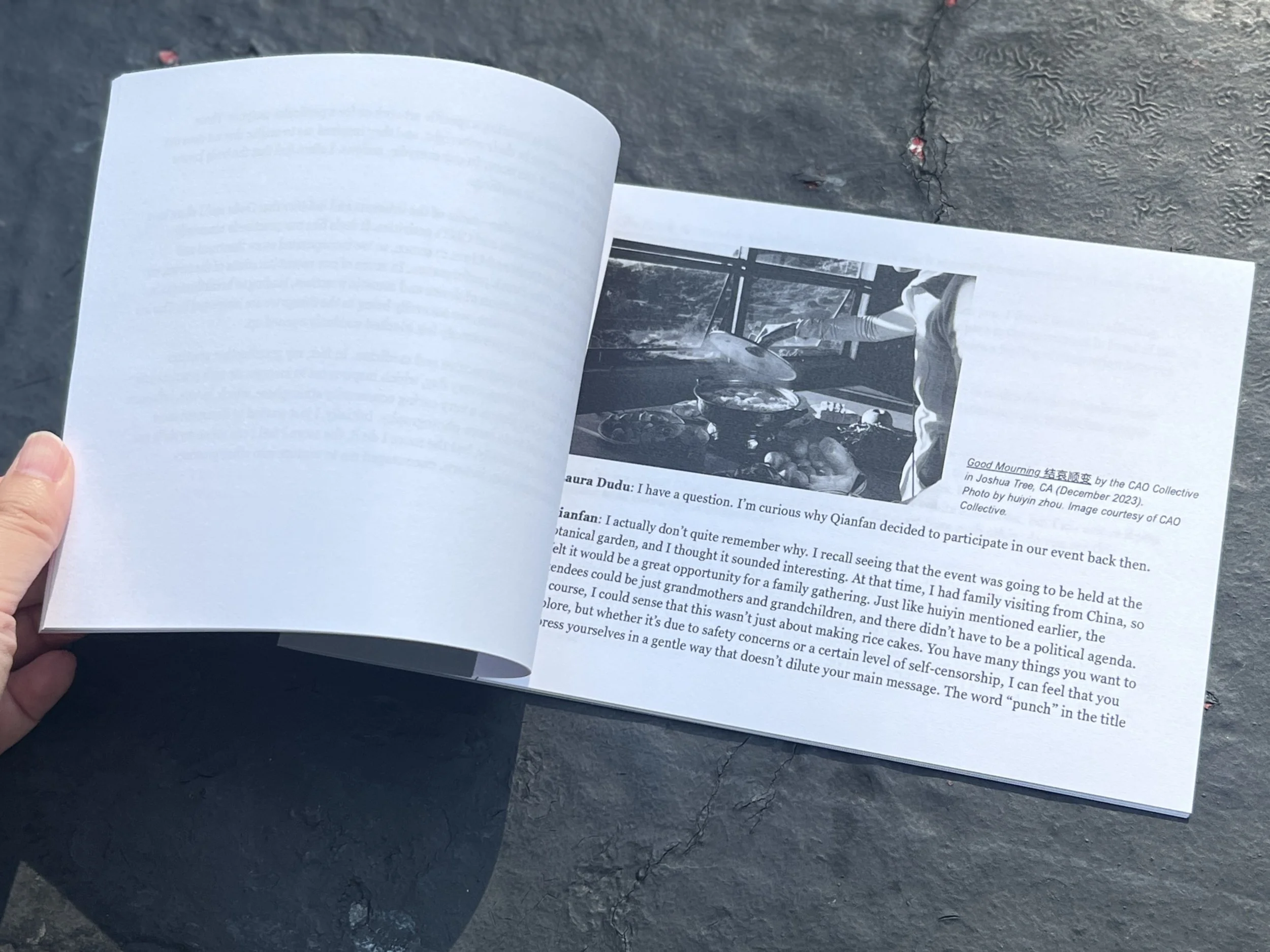
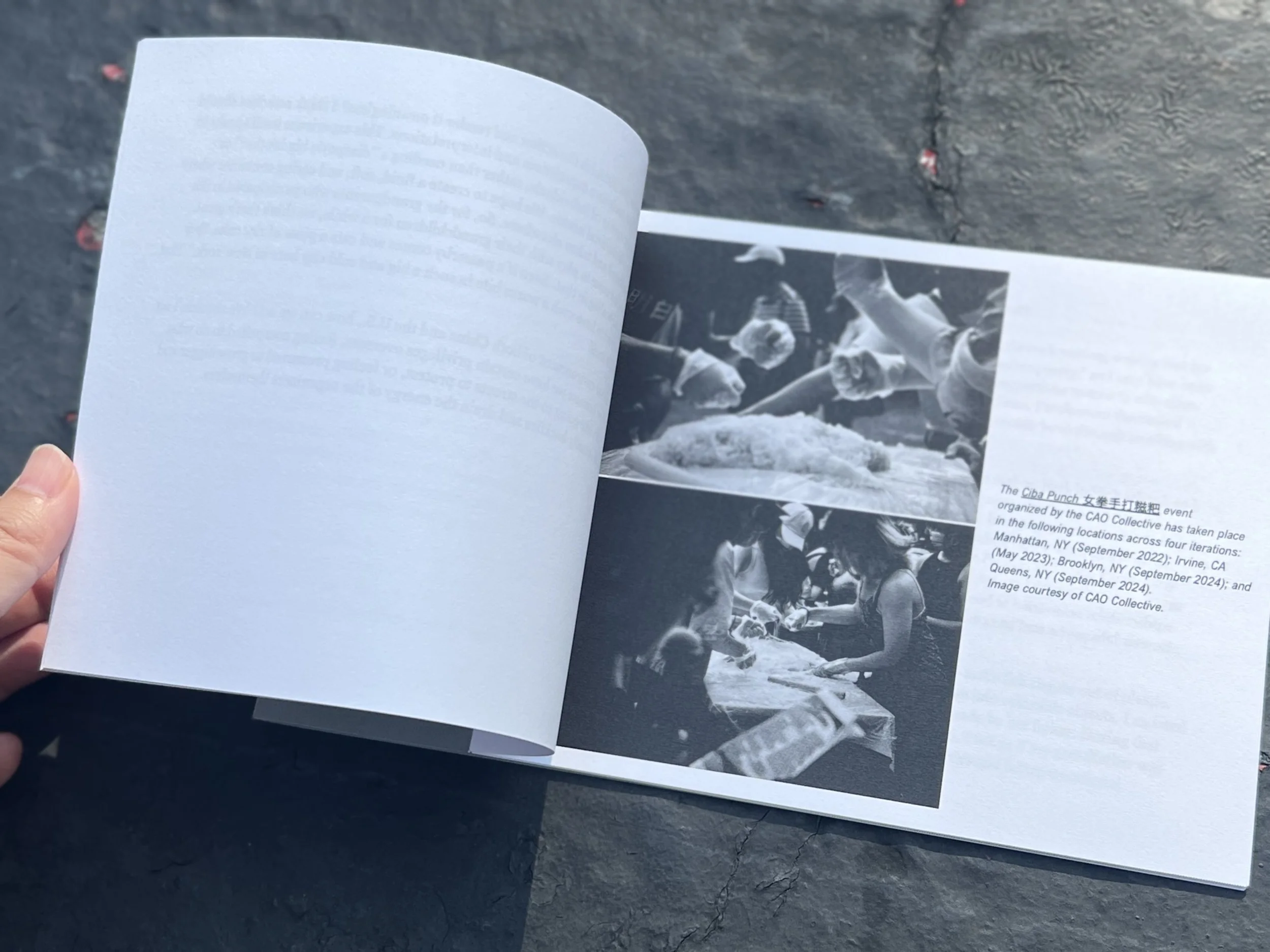
The collective’s activities creatively intertwine art and activism, often presented in a light and playful manner despite their profound political implications. By transforming vivid political metaphors into participatory art forms—such as the pun on 女权 (nüquan, “feminist empowerment”) and 女拳 (nüquan, “women’s fists”) through performances like punching sticky rice—CAO explores the intersection of individual and collective experiences. The collective aims to foster a nurturing environment where members can reconnect with their bodies and emotions, finding healing and empowerment through art while remaining attuned to the complexities of their identities and cultural heritage.
This conversation took place over online video calls in January 2026. The co-parents of CAO, Laura Dudu 嘟嘟 and huiyin zhou 徽音, generously shared their ever-evolving ideas and practices for confronting challenging socio-political circumstances through grassroots artistic expressions.
* The conversation was originally conducted in Mandarin Chinese, and was translated and edited for clarity.
More about CAO Collective:
Instagram: @caocollective
← back to all Edited Interviews
Qianfan: My first question is, why are your political metaphors so vivid, yet the activities you organize are presented in such a light and cheerful manner? For example, transforming the pun of 女权/nüquan (“feminist empowerment”) and 女拳/nüquan (women’s fists) into performances of punching sticky rice and other kinds of participatory activities.
Laura Dudu: […T]he individual person is very important. We realize that the gathering of people is precisely what many authoritarian governments do not want to see. So why does the act of gathering hold such power? Can we first focus on making gatherings happen and then grow organically from there, rather than imposing a task on a group? From my experience in various political activities, it feels as though a group of people has already decided what “we are going to do,” established an agenda, and everyone came together because of that agenda. However, what we want to emphasize is the importance of gathering people first, just like a family reunion. I believe that this act itself is artistic; it embodies creativity and vitality, allowing for the existence of a “collective” where individuals can find their own seeds and places to sprout. And because of that, we engaged in many ritualistic activities, using art to frame the essence of those activities. […]
huiyin: […] I think what we really want to contemplate is the power of art itself. This includes the many somatic healing activities we have conducted, where we ask whether we can create a space for healing for ourselves and our community through these actions. We don’t want everyone to come together to do something just to lose contact afterward, treating connection like something disposable. That feels like inviting you to join an event just to be a body and up the numbers.
“Can we first focus on making gatherings happen and then grow organically from there, rather than imposing a task on a group?”
Excerpts from the Conversation:
Qianfan: […] I find it interesting that you are all in different time zones, which means you primarily function as an online community and can only initiate offline activities at certain times, rather than engaging in highly directed protest-type movements or more “localized” practices. Perhaps because of this, your first thought is about how to gather people together… Maybe this isn’t quite a question, but I’m curious if you think this is a phase? Given that your members are quite far apart from each other, do you see this distance as an advantage or a limitation?
huiyin: I believe our situation has been continuously evolving. In the beginning, our context was rooted in the diasporic communities in the United States, which gave us a sense of finding a landing place. […] We came together through a fellowship, which is a long story in itself, but this fellowship had connections to feminist activists in North America. Initially, we gathered in this way as like-minded friends. We organized an in-person conference that had over a hundred participants, focusing on Chinese diasporic activists. During that time, there was a strong desire among us to meet in person, regardless of the challenges involved. People would fly in from various places, and when we gathered in New York, if there was no place to stay, we would crash at each other’s homes, cooking and sharing meals together while also working on projects like “Collective Poetry Writing Workshops.” It was truly an intense and intimate process. […] Gradually, we transitioned into figuring out how to maintain our online community, especially since we had many collaborators and community members back in China or in other parts of Asia. This transnational connection led us to experience a form of “online guerrilla warfare.” Now, our state exists somewhere between offline and online. […]
Overall, I believe that CAO has its own vitality and is still growing and expanding. We continue to work hard, but I feel more like a co-parent of this organization rather than framing it as a co-director. The term “direct” seems to imply a fixed direction, but now it feels more open and dynamic.
Laura Dudu: […] Hearing huiyin’s description brought me back to when we first hosted the “Ciba Punch” event under the CAO name. At that time, there were six of us crammed into a small one-bedroom apartment in Queens, about 40 square meters. I shared an air mattress with three others, with our feet nearly touching each other’s faces due to the lack of space. But even in that kind of environment, we would chat late into the night, and I thought, wow, I never expected to meet such a group of people in my twenties. I wanted to hold onto that state and not separate. Of course, I later realized that simply having that moment exist was already beautiful. […]
Returning to what Qianfan mentioned about online versus in-person interactions, we consistently discuss how everyone understands space. […] On a dream level—one of our projects is “One Thousand and One Nights 一千零一夜”—consciousness connects us. I think of the online realm as a cloud; it might not necessarily be less tangible than the offline experience, or it could represent a more embodied connection. Conversely, in-person activities can also embody a spiritual connection. It’s similar to how colors fluidly mingle together. Both online and offline can represent a more kinetic state of movement and be more spontaneous.
“CAO has its own vitality and is still growing and expanding. We continue to work hard, but I feel more like a co-parent of this organization rather than framing it as a co-director.”