Rujuta Rao
Edited Interviews | 2025-2026
Rujuta Rao (b. 1989, Goa, India) is a multidisciplinary artist whose work spans sculpture, installation, book art, and garments through her project RUGA. Her practice explores themes of migration, family history, and hospitality, creating communal experiences that challenge traditional boundaries and conventional narratives while emphasizing personal agency and the joy of creative expression.
In this conversation, which took place in September 2025, Rao reflects on the intricate relationship between her personal experiences and artistic practice, discussing themes of identity, loss, and communication. She delves into the complexities of the term “diaspora,” advocating for a nuanced understanding that celebrates exploration and transience. Additionally, Rao shares her unique perspective on reading and writing, shaped by her reading disability, and recounts a time when she created art primarily for the viewership of her mentor, Aveek Sen.
More about Rujuta Rao:
Instagram: @rujutarao
Garments by Rujuta Rao, RUGA Project, on Instagram: @rugaproject
← back to all Edited Interviews
“At this stage, the resistance is less against something than it is a realization that I can do what I want, and that my will is justification enough.”
Excerpts from the Conversation:
Qianfan: […] For us immigrants, movement is something that’s deeply embedded in our thinking. We have truly, literally left a lot behind in our home countries, and perhaps we are just smaller versions of ourselves living here. […]
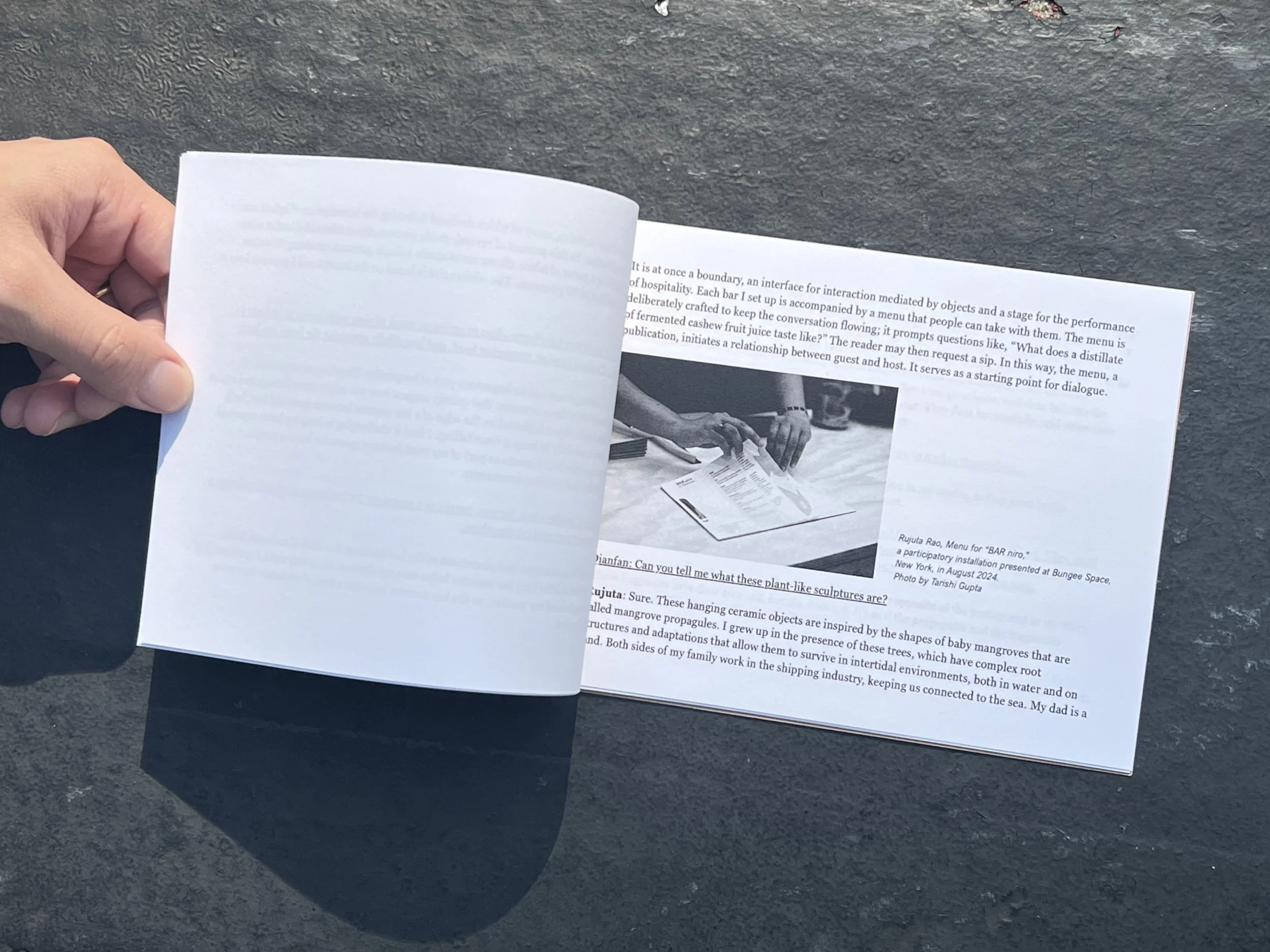
Rujuta: […] This makes me think of a small book I made recently, four risograph-printed pages about the story of the fragmented woman. I titled it Diaspore as a way to rethink the term “diaspora” and draw attention to the individual as a diasporic unit. In botany, a diaspore is a plant propagule that travels away from its parent to populate new areas. For example, each mangrove propagule is a diaspore. Learning that the word carries meaning across these different contexts has expanded how I think about the nuanced ways in which people and plants both migrate.
During my MFA in New York City, there was a strong push from some of the professors to assume the position of victim you just mentioned. Toward positioning myself as an oppressed exotic brown woman who had fled India to arrive in the United States only to find herself trapped by the immigration system and racism. That’s always the push I find myself resisting. I want my work to be read as expansively as I am, without reducing it to a few digestible categories that assuage white guilt and make the work more marketable.
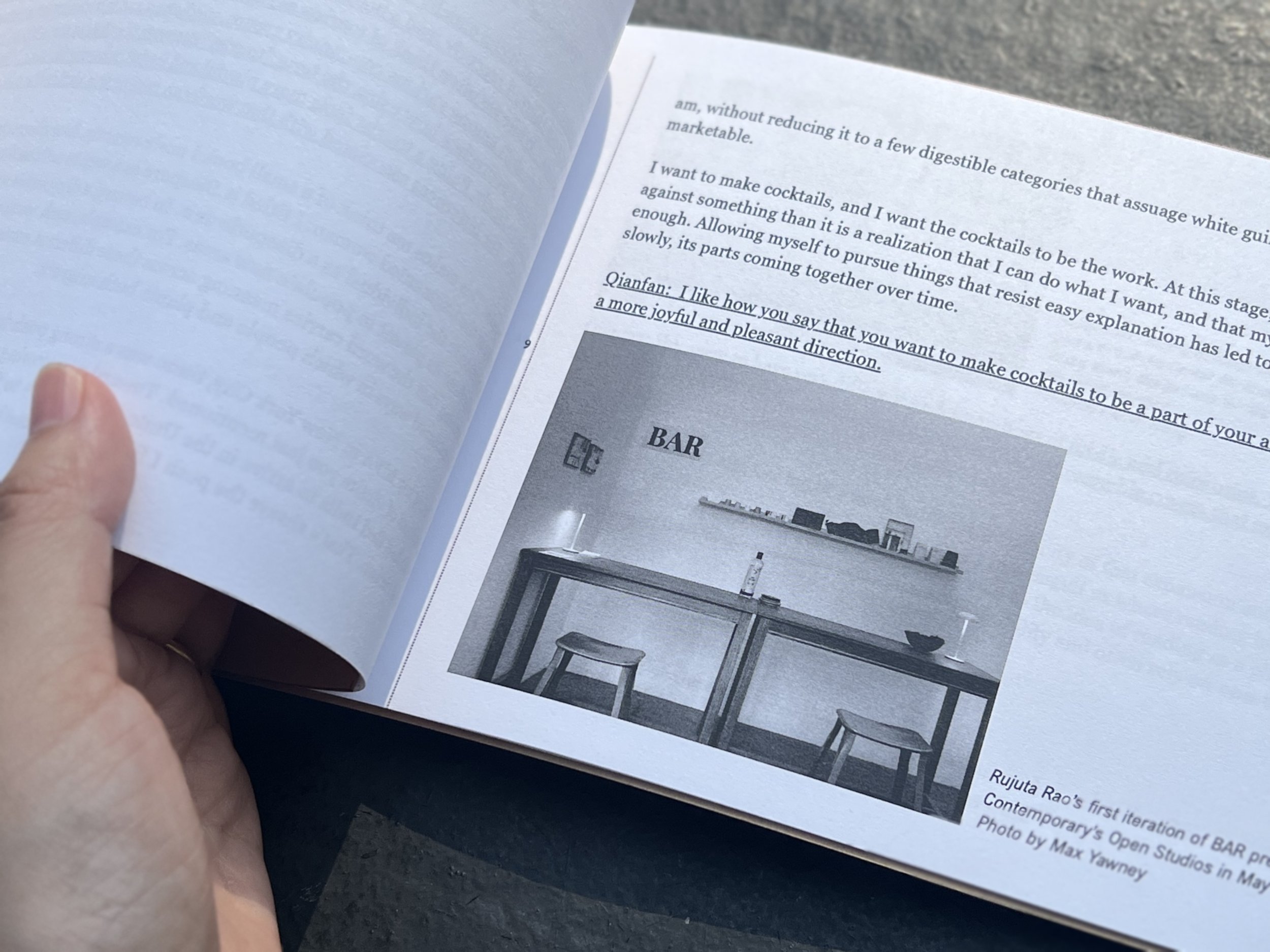
I want to make cocktails, and I want the cocktails to be the work. At this stage, the resistance is less against something than it is a realization that I can do what I want, and that my will is justification enough. Allowing myself to pursue things that resist easy explanation has led to a career that unfolds slowly, its parts coming together over time.
“Sharing work with smaller audiences, or even a single viewer, offered me unusually intimate contexts for exchange.”
Qianfan: […] You mentioned to me earlier that for four years, you made art for one viewer only.
Rujuta: That one viewer was my mentor, Aveek Sen, although he preferred calling himself my aunt rather than my mentor. He was an incredible thinker and a brilliant person. I would share my work with him twice a week over Zoom. When he died in 2021, I lost my audience, and that’s when I decided to reengage with the art world in a professional capacity and began sharing my work with a wider audience. […]
Qianfan: […] It’s different when you’re creating work for one or a few viewers, as the pieces become very specific objects. It’s also special because, as a creator, you are your first viewer. That’s akin to a writer being their first reader…
What was it like for you at the beginning of those four years when you were making art for so few people?
Rujuta: Sharing work with smaller audiences, or even a single viewer, offered me unusually intimate contexts for exchange, and the opportunity to construct those settings. When I moved from India to suburban New Jersey, I began displaying a series of changing works between the main door and storm door of our home — a vitrine-like space — to invite neighbors closer and break the insulation built into suburban architecture. After the pandemic, I began carrying works from New Jersey to individual viewers in New York City, in locations determined in collaboration — a bar, a park, or their home. The works were intended to be portable and collapsible, set up for one viewer at a time. These exhibitions paved the way for my bookmaking practice, which followed shortly after, as books are portable and most often intended for solitary readership.